
Project Overview
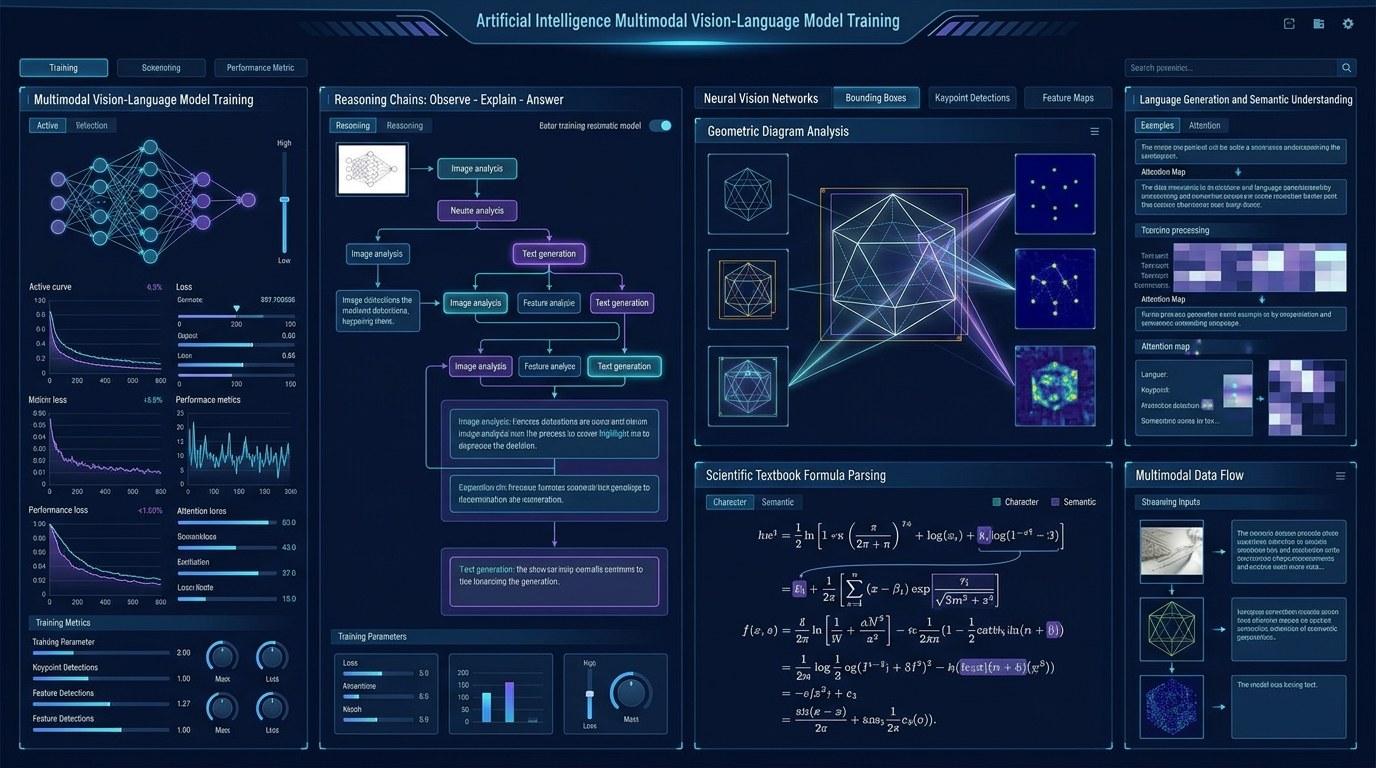
An advanced data engineering initiative deploying a 10-member specialized engineering squad to build high-precision multimodal reasoning chains (Observe-Explain-Answer) for domain-specific textbook images, scientific diagrams, and mathematical structures. Designed to train and benchmark state-of-the-art Vision-Language Models (VLMs), the project engineered automated syntactic and semantic verification pipelines in LaTeX and iMathEQ, maintaining a verified 99%+ accuracy standard across tens of thousands of complex scientific reasoning samples.
Challenges & Pain Points
Hallucinations in Complex Scientific Diagrams
Standard Vision-Language Models frequently hallucinated spatial geometry, misread overlapping graph lines, and failed to associate diagram labels with algebraic equations.
Malformed LaTeX & Math Formula Inconsistencies
Raw OCR systems produced syntactically broken mathematical equations, inconsistent symbol naming, and non-compilable LaTeX expressions, corrupting VLM tokenizers during training.
Lack of Grounded Step-by-Step Reasoning
Existing visual QA datasets only provided final answers without intermediate cognitive steps, preventing models from learning structured reasoning and explainable derivations.
Our Solution
Observe-Explain-Answer Reasoning Methodology
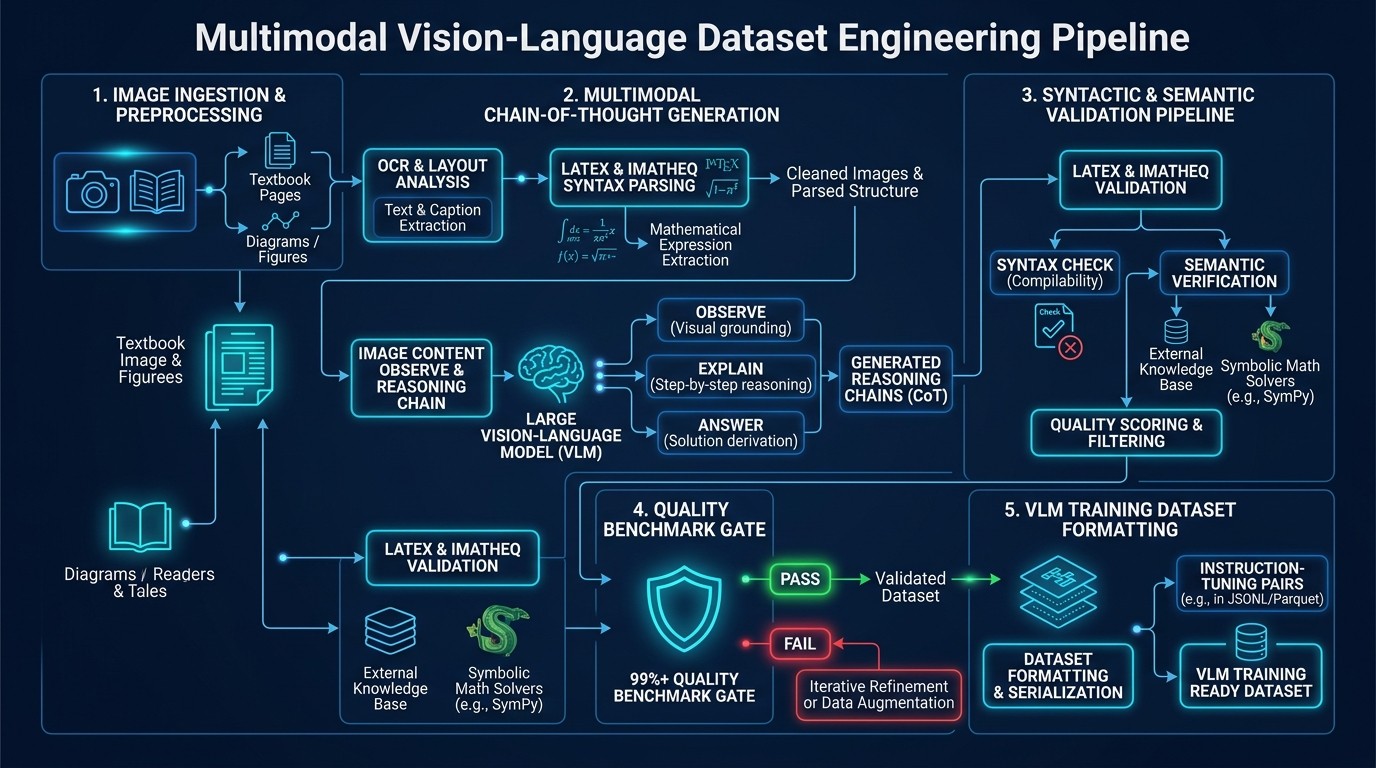
Instituted a rigorous 3-tier cognitive framework: Observe (explicitly grounding all visual entities, geometric coordinates, and axes), Explain (deductive step-by-step mathematical reasoning), and Answer (exact solution derivation).
Automated LaTeX & iMathEQ Compilation Pipeline
Engineered automated validation tools that compile every mathematical expression via headless LaTeX engines and symbolic solvers (SymPy) to detect syntax anomalies, bracket mismatches, and numerical discrepancies before ingestion.
Engineering Governance & Quality Calibration
Implemented multi-pass peer review workflows, regular calibration sessions, and automated linting scripts, maintaining a strict 99%+ accuracy threshold across the entire multimodal dataset.
Technology Stack
Multimodal AI & Dataset Engineering Domain Expertise
Vision-Language Grounding & Alignment
Specialized techniques for multimodal spatial grounding, chart question-answering, visual chain-of-thought prompting, and high-fidelity mathematical diagram comprehension.
Scientific Formula Parsing & Serialization
Mastery of mathematical typography standards, LaTeX AST manipulation, iMathEQ representation, and automated symbolic equivalence verification.
Project Highlights
- Specialized engineering squad building precision AI training pipelines
- Observe-Explain-Answer reasoning chains for scientific and textbook diagrams
- Rigorous automated LaTeX and iMathEQ syntax validation pipeline
- Verified 99%+ accuracy standard across thousands of training samples
- Dataset formatting optimized for state-of-the-art Vision-Language Models (VLMs)